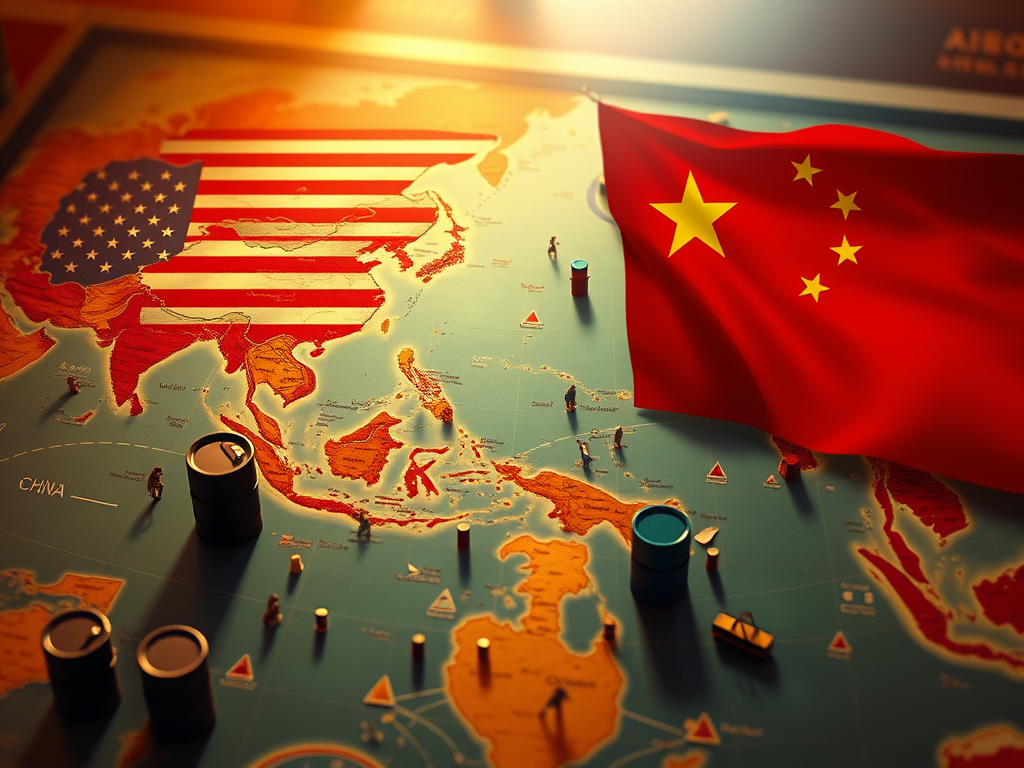
Instability in the Middle East appears geographically distant from Indonesia. But viewed through the lens of game theory, it becomes clear that events in the Gulf are not peripheral to Southeast Asia’s future. They are a strategic variable in the intensifying rivalry between the United States and China – a rivalry whose consequences increasingly flow through energy markets, shipping lanes, and emerging economies like Indonesia.
This article applies a simple game‑theory framework to explain:
- Why Middle East disruption can advantage the US relative to China
- Why Indonesia bears significant second‑order costs
- Where Indonesia has real strategic leverage
- What is most likely to happen next
The strategic setup: why game theory helps
Game theory is useful when outcomes depend not on one actor’s choices, but on interacting strategies.
In the Middle East context:
- The United States chooses how aggressively it prioritises stability versus tolerating disruption
- China chooses whether to remain an economic actor or assume security responsibilities
- Indonesia and ASEAN are not players in the core game – but they are deeply affected by its outcomes
This creates a classic asymmetric payoff structure.
The US–China game‑theory matrix (simplified)
Broadly speaking, the US can adopt a strategy of:
- Stabilisation (de‑escalation, energy security guarantees); or
- Tolerated disruption (accepting or exploiting instability).
China can adopt a strategy of:
- Economic‑only engagement
- Security‑inclusive engagement
Relative strategic payoffs
(US payoff, China payoff – relative, not absolute)
| China: Economic‑only | China: Security‑inclusive | |
| US: Stabilisation | (Medium, High) | (Low–Medium, Medium) |
| US: Tolerated disruption | (High, Low) | (Medium, Low–Medium) |
Key insight:
The outcome highlighted in bold – tolerated disruption while China remains economically focused – produces the largest relative advantage for the US and the greatest strain on China’s growth model.
This does not require intent or conspiracy. It arises from structural asymmetries in energy dependence, maritime security, and economic resilience.
Where Indonesia sits in this game
Indonesia is not a player in the US–China game – but it is not neutral to the outcome.
1. Impact on Indonesia: why disruption hurts
Indonesia’s exposure comes through three channels:
Energy prices
- Indonesia is now a net oil and LPG importer
- Volatility directly pressures fuel subsidies, inflation, and fiscal balance
Trade and logistics
- Disruption in the Middle East raises shipping insurance, freight costs, and input prices
- These costs feed into food prices and manufacturing competitiveness
Macroeconomic stability
- Energy‑driven inflation is politically sensitive
- Growth volatility complicates long‑term investment planning
In game‑theory terms, Indonesia experiences negative externalities regardless of which great power “wins”.
2. Indonesia’s overlooked opportunity: geography as leverage
What Indonesia lacks in hard power, it gains in structural relevance.
Indonesia sits astride:
- The Strait of Malacca
- The Sunda Strait
- The Lombok Strait
Together, these form the primary corridor linking Middle Eastern energy to East and Southeast Asia.
This gives Indonesia:
- Strategic relevance to both the US and China
- Leverage without militarisation
- A role as a stability stakeholder, not a partisan actor
In game‑theory terms, Indonesia is a pivotal node in the payoff transmission mechanism.
Indonesia’s revealed strategy (what it is already doing)
Indonesia’s recent behaviour is consistent with a rational response to this game:
1️⃣ Diversifying energy risk
- Reducing reliance on Middle Eastern LPG
- Increasing imports from the US and other suppliers
- Accelerating domestic substitutes where possible
2️⃣ Preserving strategic optionality
- Maintaining strong ties with China (trade, investment)
- Maintaining credibility with the US (energy, maritime norms)
- Avoiding formal alignment that would reduce flexibility
3️⃣ Emphasising stability, not alignment
- Supporting freedom of navigation
- Avoiding securitisation of chokepoints
- Keeping ASEAN centrality intact
This is not indecision. It is equilibrium‑seeking behaviour.
What is most likely to happen next
From a game‑theory perspective, three outcomes are plausible:
Scenario 1: Managed instability (most likely)
- Periodic Middle East disruptions
- China absorbs higher costs but avoids deep security entanglement
- Indonesia continues hedging and energy diversification
Scenario 2: China adapts
- China incrementally expands security and diplomatic roles
- Payoff asymmetry narrows
- Indonesia faces more pressure to balance competing expectations
Scenario 3: Prolonged disruption (worst case for Indonesia)
- Structural energy volatility
- Persistent inflation
- Greater strain on ASEAN cohesion
Across all scenarios, Indonesia’s best outcome comes from stability – but its strategy must assume volatility.
The strategic takeaway for Indonesia
Game theory clarifies a crucial point:
Indonesia cannot control the US–China game – but it can shape how the payoffs flow through Southeast Asia.
That requires:
- Treating energy security as strategic, not merely economic
- Protecting maritime relevance without escalation
- Preserving non‑alignment as a form of risk management, not passivity
In a world where great‑power rivalry increasingly operates through indirect theatres, Indonesia’s advantage lies in remaining indispensable without being entrapped.
 Ten Eighty Consulting Indonesia
Leave a comment