KADIN’s Indonesia Emas 2045 Roadmap white paper is a treasure trove of information and ideas for entrepreneurs interested in doing business in Indonesia.
Indonesia Emas 2045 (Golden Indonesia 2045) is the Indonesian government’s vision for where the country will be 100 years from declaring independence in 1945. It is projected that Indonesia will be 4th largest economy (by GDP PPP) and the 8th largest economy (by real GDP). The government’s plan consists of four pillars:
- Boost resiliency: building unrivalled health resiliency and establishing a self-sustaining food security ecosystem
- Foster prosperity: grow high value sectors through unlocking lighthouses in strategic manufacturing sectors, leapfrogging growth in financial services, building world-class ecotourism destinations, unleashing global creative players, and accelerating MSME growth to mid-size, globally competitive companies
- Strengthen inclusivity: becoming the role model of end-to-end transformation of healthcare ecosystem, and empowering the vulnerable population
- Advance sustainability: becoming the world reference in innovative and affordable decarbonization, and setting up the world’s largest hub for green business build to reach Net Zero by 2060
It is interesting to put the numbers in context. For the vision to be realised, Indonesia will need to get to GDP per capita of USD23,603 by 2045. By way of comparison, Australia’s GDP per capita as at December 2022 was USD60,994. It is population (Indonesia’s 276 million v. Australia’s 26.27 million as at December 2022) that will move Indonesia up the list of the world’s largest economies, and Indonesia’s growing middle class will continue to be one of its most interesting market segments.

In its white paper, KADIN has identified challenges in achieving the ambitious goals of Indonesia Emas 2045, and solutions to address them. The report sets out – for each of the government’s four pillars – a set of ‘bold moves’ that should be undertaken and what roles MSMEs can play. A veritable laundry list of business opportunities. KADIN predicts that without its proposed “bold moves” Indonesia will realise only 65% of its GDP target, whereas with them it will achieve 90-110%.
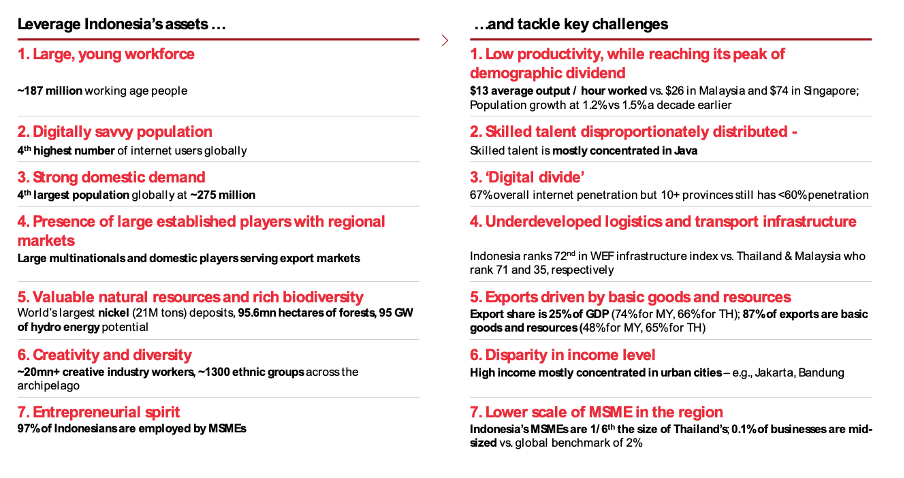
One particularly interesting part of the report was a list of Indonesia’s assets and key challenges. These should feature in environmental analyses and SWOT assessments in strategic planning.
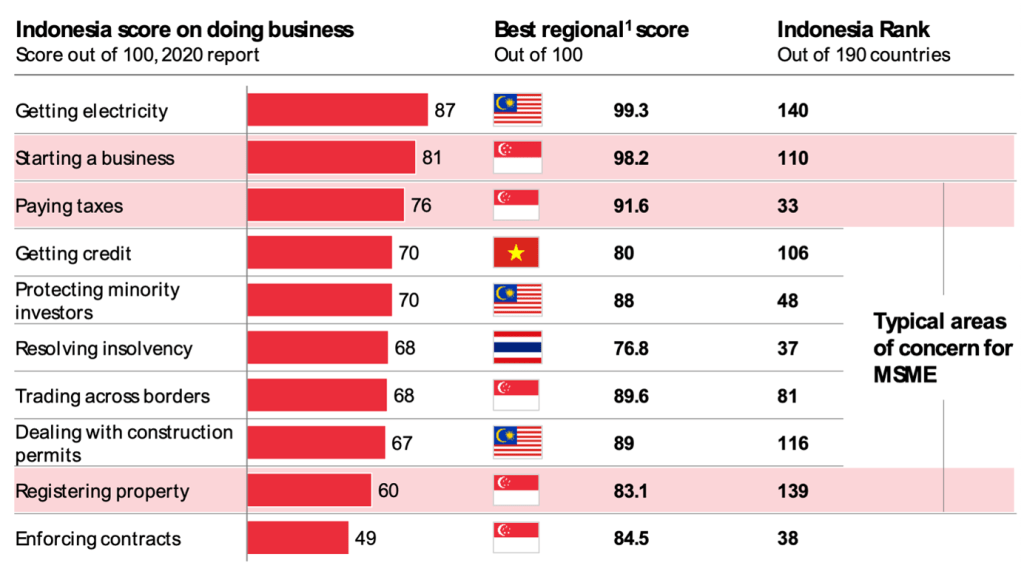
Entrepreneurs unfamiliar with the regulatory landscape might also find the comparative (with its neighbours) analysis of Indonesia’s ease of doing business score interesting.
 Ten Eighty Consulting Indonesia
Leave a comment